3 When the centurion heard about [Yeshua], he sent some [Judahite] elders to Him, requesting Him to come and save the life of his slave. So this Roman centurion heard about Yeshua of Nazareth and decided that he would send to Yeshua some of his friends who were elders in the nation of Judah. He probably reasoned, "Yeshua is from Judah. He'll listen to these elders." Notice again (as I mentioned in the last post), this centurion loved his slave. He wanted his life saved, physically.
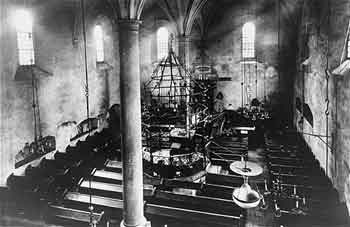
The elders got to Yeshua and pretty much begged him to come and heal the slave of the centurion. Verses 4-5 tell us at least two reasons (probably one, branching out to two) that they felt the centurion was worthy for his slave to be healed. 1. He loves our nation 2. He built us a synagogue We aren't specifically told if the centurion did any of the actual building (as in carpentry or stone work with his hands) or if he paid for the synagogue to be built. Either way (the latter is more likely) he was responsible for one of their synagogues. The elders of Judah looked up to this centurion because he thought enough of their nation (he obviously was not a Judahite) to build them a synagogue. I can't tell you how many times I've heard something like this: "The church isn't the building, it's the people." I used to think that was a pretty good cliche. I've come to believe that it's not really that good at all. I'm not saying that the people aren't important; they are. But I'm also not going the say the building is not important; it is. At least if you believe Luke 7:5. You can read through the New Testament, and you can find where people met in their homes for worship. Sure, that's acceptable, but please don't pit one set of verses against another set of verses. There are numerous verses that speak of the first century synagogue, a special place, a special building, dedicated for the purpose of worshiping the Father on new moons and sabbaths. It is healthy to have a place that is set apart for worship. A place different than where you hang out the other days of the week. A place that is holy, so to speak, in the sense of set apart. There's a sense of awe about it. A good awe, not an idolatrous awe. The Old Testament tabernacle is certainly not the New Testament synagogue, but in studying about the tabernacle, the building, we see that Yahweh was very particular about a special place, and special "pods" within that place, where He was to be approached. I think that having a place, building a synagogue (like the centurion did for the nation of Judah) is a good thing to do. It's not something to be discarded with a cliche like, "The church is the people, NOT the building." No, the church is the people AND the building. This doesn't mean people cannot meet under an oak tree or in a living room. It just means that we recognize that if we have the ability, the route to take is to have a designated place of worship where our families can "escape the world" for a while and come before the King. ~ Matthew
0 Comments
 Luke 7:1-2 HCSB I'll soon be teaching through Luke chapter 7. I started teaching through this gospel a few years ago and have made it all the way through chapter 6. Chapter 6 changed my life, specifically verse 20 to the end of the chapter.
I've been reading Luke 7 for quite some time now in preparation for my teaching, and I've decided to get a jump start on the text by chronicling my thoughts here. So this will be the "Matthew Janzen Commentary on Luke 7" I guess. Verse 1 has Yeshua concluding all of his sayings recorded in Luke 6:20 onward. He then enters the city of Capernaum, or as it was known then, Kafar-Nahum, meaning "Village of Comfort." I've got a friend of mine that has taken a few lengthy trips to Israel; he, his wife, and seven children. I remember him telling me a story about a fellow there, I believe it was some sort of guide, sharing about a city, the city of Kafar-Nahum. My friend told this guide that he'd never heard of that city or seen it in Scripture. Little did my friend know that the city he was accustom to calling Capernaum was nothing but a butchering of the actual Hebrew name Kafar-Nahum. So Yeshua enters this city, a city in the area of Palestine, and Luke tells us of this slave of a centurion. A centurion was a Roman officer that had about 100 men under his authority. Centurions were themselves under authority (as we will later see in this section), but were nonetheless the authority themselves over 100 soldiers. The main point I want to focus on in Luke 7:1-2 is the fact that this centurion had what the verse calls a slave. We hear the word slave today and all kinds of thoughts pop into our head. We think of harsh slavery, civil rights, we may even wander back to the exodus of the Israelites from their slavery to the Egyptian taskmasters. But here, we see that this slave of the centurion was highly valued. He was special. He was so special that the centurion wanted his sick slave to be made well. The centurion didn't want his slave to die from this sickness. I get the feeling from the verse that this wasn't because the centurion wanted to beat him to a pulp with work, but rather because the slave was loyal to his master. The slave was highly valued by his master. The master took good care of his slave. At these points in reading Scripture we must not force what we've been taught to contradict the text. Sometimes we do this subconsciously. What I mean is that we generally think of all slavery as wrong. We hear the word slavery and we think "that is terrible." It is true that slavery can be a terrible thing, but according to this verse there is a form of slavery that is quite acceptable. The centurion had a slave, a servant. This servant served his master, did it well, and was valued because of this. The servant was taken care of, housed, fed, and treated with respect himself. He wasn't on the same level of authority as the centurion, but he still was a respected slave. Nothing negative is said about this relationship. If we believe the Bible, we should have no problem believing what this verse implies. I think we often read through texts like these in Luke and glance over these smaller nuggets by rushing to the bigger picture in the story. There certainly is a bigger picture, but that doesn't mean the smaller snapshots are of no significance. ~ Matthew  Marriage is a covenant between you, your spouse, and the Creator.
No marriage is perfect. It's two sinners loving each other and forgiving each other. You don't do alone time or private time in marriage. You and your spouse are one flesh. Hang out together. If you don't keep adding wood to the fire, it goes out. Love covers a multitude of sins. No husband loves his wife like Christ loves the church. He should, but he doesn't. Have a lot of sex. Then have some more. Listen to people who've been married for 50 plus years. They gotta know something. Hold your wife's hand. She likes that. Don't let yourself go. Nobody's gettin' any younger, but that don't mean we quit combing our hair. Love keeps no record of wrongs. Marriage ain't about making yourself happy. It's about being happy, together. Drink wine together. The good stuff. Make anniversaries special. Repent openly. Don't stop kissing. Tell him/her "I love you" and let 'em know you mean it. Get over the small stuff. Neither of you have it all together. Open her car door guys. Pray together, and for each other. Go to church. Forgive. Don't bring up the past. Laugh together. Cry together. Laugh some more together. Anybody can slow dance. Do it. Go on dates. Leave your phone in the car. 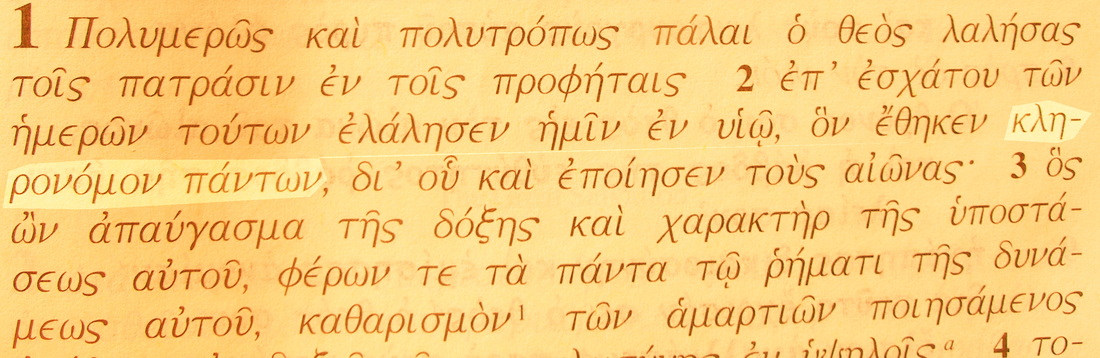 Yahshua: Did He Pre-Exist? (Pt. 2) The Word "By"Yahweh created the world "by" (through) the Son (Hebrews 1:2 KJV). The Diaglott says Yahweh created the world "on account of" the Son. Any one of the three ("by," "through," or "on account of") is technically a correct translation of the Greek word di' or dia. Dia is in the KJV translated several ways, but usually it is translated as follows: by - 243x through - 100x for - 106x because - 24x because of - 29x for the sake of - 32x The King's men did not translate the word di' incorrectly in Hebrews 1:2. By or through [are] correct translations of the word, but ONLY IF THE MESSAGE in the sentence agrees, or allows it. But alas, in this case the message of the sentence will not allow this translation. Reason #1: Hebrews 1:2a reveals Yahshua to be the heir of what was created [see part 1 of this study]. Reason #2: More than 100 Scriptures show it was Yahweh (not Yahshua) who created the heavens and the earth. Hebrews 1:2 must agree with the 100 other Scriptures. For a list of these, see our paper, "Who is the Creator?" Editors Note: You will find this paper For these reasons, the sentence in Hebrews 1:2b must have originally read much like the Diaglott reads today, Yahweh "...in the last of these days spoke to us by a Son, whom he appointed heir of all things, ON ACCOUNT OF whom he constituted the ages." Another acceptable translation would be, "...a Son, FOR whom he created the world." Many times the King James Version as well as more modern versions translate dia as "for," "because of," [or] "therefore" (meaning "for this reason"). For a more detailed layout of the word di' (dia), ask for the paper, "Hebrews 1:2 - Berry." This is not to say the King's men purposely mistranslated, nor is this to say they were dishonest. Not at all. On the contrary, they no doubt delivered what they believed to be a correct translation of Hebrews 1:2. We must realize, however, that all of the King's men believed the doctrine of the Trinity (one is three, and three are one). Believing this, they saw no contradiction between this Scripture (as they translated it) and the 100 Scriptures which show that Yahweh the Father is truly and personally the Creator of heaven and earth. There are at least two other Scriptures in which di' should have been translated for, or on account of. These are Colossians 1:16-17 and John 1:10. Let us review these Scriptures, then return to our study in the book of Hebrews. Colossians 1:16,17For by him (Yahshua) were all things created, that are in heaven, and that are in earth... all things were created by him and for him. (Colossians 1:16,17 KJV) Just as in Hebrews 1:2, di' can be translated for, and on account of, as well as by or through. As indicated above, either way is technically correct for this word. However, the MESSAGE in this text must decide which is the proper translation. The same is true of the Greek word en (= the English in). Since Yahweh is the Creator (Hebrews 3:4; Exodus 20:11; Matthew 21:33; Mark 12:7; Luke 20:14 [etc.]), and Yahshua is the heir, then Colossians 1:16-17 SHOULD TELL THE SAME STORY. Dozens of Scriptures in both Testaments tell us plainly that Yahweh is the Creator, and there is no other El but him. He alone is the only true El, Eloah, Elohim, and Creator. Yahshua and the New Testament writers proved everything by Old Testament Scriptures, therefore New Testament Scriptures should (and originally did) agree with Old Testament Scriptures. The New Testament Scriptures are based on the older ones. This being true, it seems that a more exact reading of Colossians 1:16-17, and one which is agreeable to the Greek text, is as follows: For in (en = in, to, unto, by) him were all things created, that are in (en) heaven, and that are on earth... all things were created on account of (di') him and for him. John 1:10He (the light, Yahshua) was in the world, and the world was made by him, and the world knew him not. (John 1:10, KJV) As we have discovered above, to agree with other Scriptures, and with the context of the message, a more acceptable reading is as follows: He was in the world and the world was made for (di' - on account of, because of) him, and the world knew him not. |
AuthorBlog by Matthew Janzen. Lover of Yahweh, Yeshua, my wife and 5 children. All else is commentary. Archives
December 2023
Categories
All
|
 RSS Feed